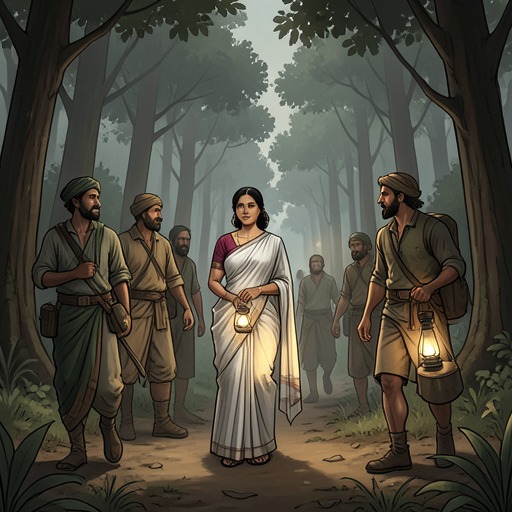
Aouda Escapes Suttee
Around the World in Eighty DaysAouda’s escape from suttee is the decisive human consequence of Phileas Fogg’s journey through India: what might have been only a segment in his race against the clock becomes an intervention that saves Aouda from a terrible death and ultimately leads to their marriage. The event also changes the meaning of the route itself. Fogg later insists that he could have completed the world tour faster by not crossing India, but that shortcut would have cost him the encounter that altered both their lives.
Background and Stakes
The rescue takes place against the novel’s account of India under British rule. Its geographical and political exposition distinguishes the broad subcontinent from British India proper, describing the Crown’s dominion over much of the country while noting that some regions and rulers remained outside it. This is the setting in which Aouda faces death and cannot safely stay: Fogg explains that her safety requires taking her far enough away that her persecutors cannot reach her.
Fogg’s conduct before the rescue is marked by strict attention to the itinerary rather than to the places along it. Aboard the Mongolia in the Red Sea, he shows no outward concern for the weather’s capacity to delay the ship and passes the voyage in routine meals and whist. At Bombay, he keeps to his schedule and declines to see the city’s celebrated buildings and nearby historic sites. Against that habitual indifference to scenery, the journey through India acquires a consequence he could not reduce to a timetable: it brings him into a position to save Aouda.
Rescue and Protection
The supplied account makes the rescue’s stakes clear through its aftermath. Aouda recalls that Fogg did more than save her from a terrible death: he also undertook to secure her comfort in a foreign land. Fogg answers that she could not remain in India and that her safety depended on carrying her far from those who threatened her. The rescue therefore does not end with her immediate escape; it continues as protection and relocation, with Fogg taking responsibility for her security beyond the danger from which she was saved.
The contrast between the danger and Fogg’s measured manner sharpens the event’s significance. His passage through the Red Sea is described through the ship’s rolling, the wind, and the possibility of delay, yet he gives no outward sign of anxiety. In Bombay he refuses the distractions of sightseeing to attend to his arrangements. His precision remains visible, but the India crossing ultimately serves a purpose beyond punctuality: it makes Aouda’s rescue possible.
Consequences and Meaning
After the journey, Fogg explains that avoiding India could have reduced the world tour to seventy-eight days. He immediately rejects that faster route as an adequate measure of success: without crossing India, he would not have saved Aouda, and she would not have become his wife. The rescue thus changes the value of the wager’s apparent calculation. The shorter itinerary represents lost time saved only by giving up the relationship and act of protection that came from the longer road.
Aouda’s escape is consequently both a reversal of immediate fortune and a turning point in Fogg’s journey. She moves from a perilous situation in India to safety in a foreign land, while Fogg’s own account of the trip comes to include more than the deadline he set himself. The rescue gives the route a human consequence that its distances and timetables cannot measure, and its lasting outcome is their marriage.